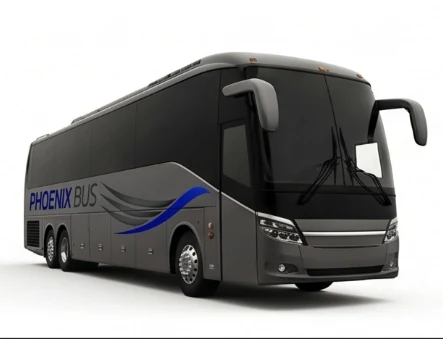
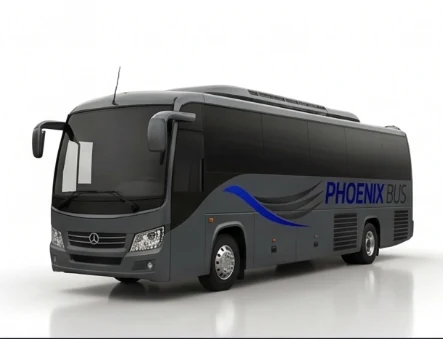
Construction Site Shuttle Bus Services & Job Site Logistics
Orlando's Premier Asset-Based Fleet — USDOT/MC Certified, GSA Contracted & DOD/DOW-Approved with a fully company-owned fleet. Phoenix Bus Orlando operates dedicated construction site shuttle bus programs — moving workers between remote parking lots, staging yards, hotels, and active job sites for large-scale construction projects, hyperscale data centers, and federal infrastructure builds. Owned 60+ vehicle fleet, DOT-certified chauffeurs, and centralized 24/7 dispatch.
Dedicated worker transport for mega-project construction sites — highways, energy, ports, and stadium builds — with pre-staged vehicles and shift-aligned dispatch windows.
Data Center Programs
Hyperscale data center campus shuttles (Google, Meta, AWS-class facilities) covering perimeter-secure gate access, badge-controlled loops, and 12-hour shift rotations.
Off-Site Parking Loops
Continuous shuttle circuits between off-site employee parking lots and active job sites — reducing on-site congestion and neighborhood impact for general contractors.
Fleet Amenities
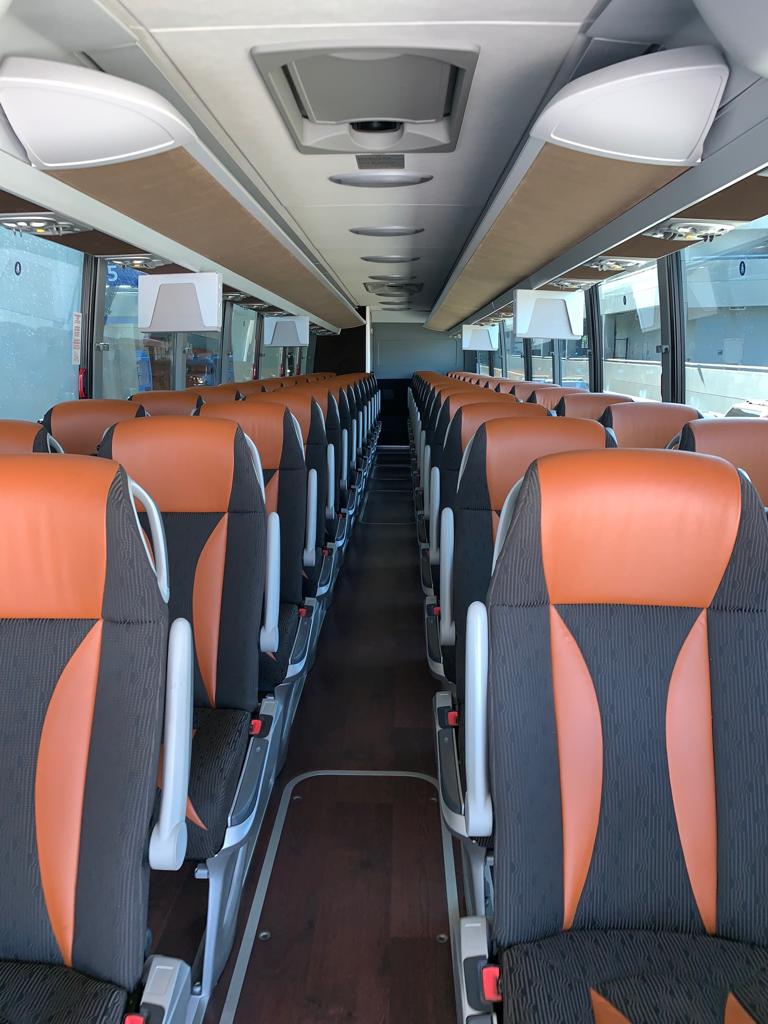
Air-conditioned motorcoaches, mini coaches, and sprinter vans with leather seating, Starlink Wi-Fi, and USB power — DOT-certified chauffeurs on every vehicle.
On-Property Route Flexibility
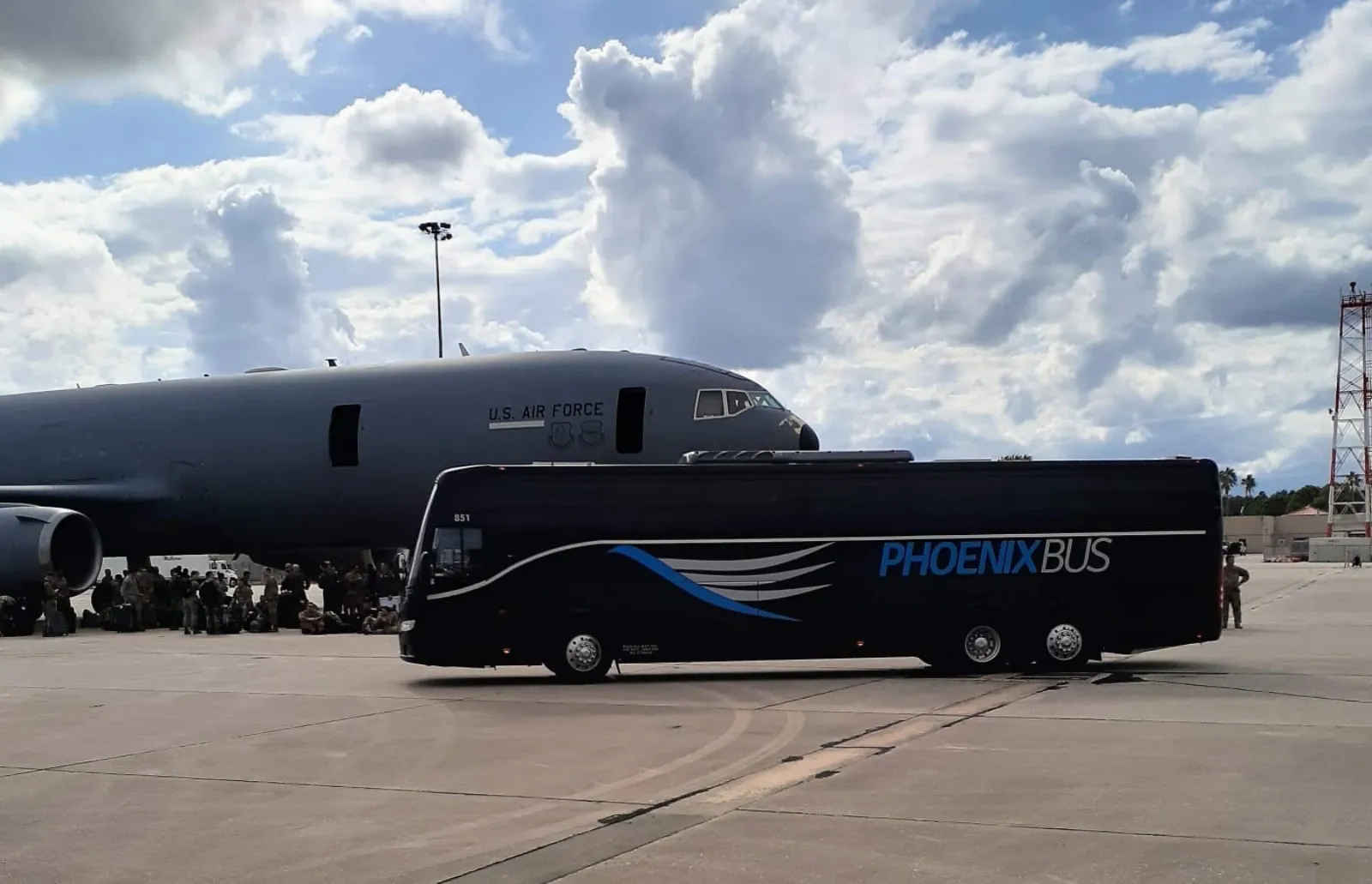
Approved for internal routes inside private construction properties, laydown yards, and secured federal / DOD job sites. Worker transport between lodging camps and active sites.
Continuous Contract Support
Daily, weekly, monthly, and multi-year shuttle contracts with dedicated account managers, fixed-rate agreements, and guaranteed backup capacity.
Construction site shuttle programs are not a rental — they are a long-running operations contract. Phoenix Bus builds every construction shuttle around three fixed variables: shift start / end times, gate access windows, and worker headcount per loop. Every operation is executed with our own fleet, our own DOT-certified drivers, and our own dispatch.
Within Central Florida, workforce shuttle coverage is concentrated on the region's active expansion corridors: the I-4 Beyond the Core corridor, the Epic Universe / Universal Boulevard construction and expansion area, Lake Nona Medical City, and the MCO Terminal C expansion zone. Routing in each of these areas is planned around local access restrictions, off-site staging lot availability, and the surrounding roadway peak periods.
Standard operating configuration covers 05:00 and 17:00 shift changes, off-site staging lots for worker parking and vehicle hold, and per-vehicle passenger manifests recorded at each pickup and drop. Programs are run in conformance with applicable OSHA site safety requirements, DOT vehicle and driver regulations, and FMCSA hours-of-service and drug and alcohol testing rules under active interstate authority (USDOT 1882749 / MC 678853).
Vehicles assigned to Florida construction work are specified for sustained heat and humidity: heavy-duty, high-output air conditioning sized for full-load operation in summer conditions, and 3-point seat belts at every seating position.
Project managers, construction superintendents, and site logistics leads can request a fast quote above or call dispatch at (321) 415-7255 to scope shift-count, vehicle mix, and contract length.
Job Site Logistics for Data Centers, Infrastructure & Federal Projects
The largest construction projects in the U.S. — hyperscale data centers (Google, Meta, AWS-class hyperscalers), federal infrastructure builds, port expansions, and stadium construction — all share a single operational bottleneck: getting hundreds to thousands of trades workers on-site at the exact minute the shift starts, without overwhelming the surrounding roads. Phoenix Bus solves that with structured shuttle loops running from off-site employee parking lots, hotel clusters, and lodging camps directly to badge-controlled gate access points.
Off-Site Parking Shuttle Programs for General Contractors
For general contractors operating under municipal traffic mitigation agreements or strict job-site footprints, on-site staging and parking are often capped. Our off-site parking shuttle loops seamlessly transfer workers from remote staging lots to the job-site perimeter on custom 10-, 15-, or 20-minute cadences—precisely synchronized with primary and secondary shift changes. To ensure zero operational downtime across all active state networks, Phoenix Bus maintains strategically positioned regional staging protocols and backup fleet capacity ready for rapid deployment, backed 24/7 by our central dispatch command.
Federal, DOD & DOW Job Site Access
As a GSA Fleet Vendor (Contract 47QMCB24D000C) and DOD / DOW-Approved operator, our chauffeur roster carries the background checks and federal credentials required to access secured government construction sites and military installations. Phoenix Bus holds an active federal delivery order for shuttle bus services at U.S. Coast Guard Training Center Yorktown (TRACEN Yorktown) under the Department of Homeland Security, awarded under our GSA Multiple Award Schedule contract (47QMCB24D000C). The same driver credentialing and vetting standards used for this federal installation apply across our construction and infrastructure shuttle contracts.
Central Florida Coverage Areas & Shift Operating Profile
Workforce shuttle coverage in the Orlando metro is organized around four expansion areas: the I-4 Beyond the Core corridor, the Epic Universe / Universal Boulevard area, Lake Nona Medical City, and the MCO Terminal C expansion zone. Each area is routed independently, with off-site staging lots used for worker parking and for holding vehicles between loops so that no equipment idles on the active site footprint.
Shift changes: primary loops built around 05:00 and 17:00 shift changes, with pre-shift arrival buffers and post-shift return cycles.
Staging lots: off-site support parking used as the boarding point and as the vehicle hold area during the mid-shift gap.
Manifest control: a passenger manifest is maintained per vehicle per run, with headcount reconciled at boarding and at drop.
Compliance: operations run in conformance with applicable OSHA site safety requirements, DOT vehicle and driver standards, and FMCSA hours-of-service and testing rules.
Vehicle Specification for Florida Climate Conditions
Vehicles assigned to construction workforce loops in Florida are specified for sustained heat and humidity exposure: heavy-duty, high-output air conditioning rated for full-load operation during summer midday conditions, and 3-point seat belts at every seating position. Units are maintained on preventive service intervals performed in-house.
Onboard Amenities & Vehicle Interior
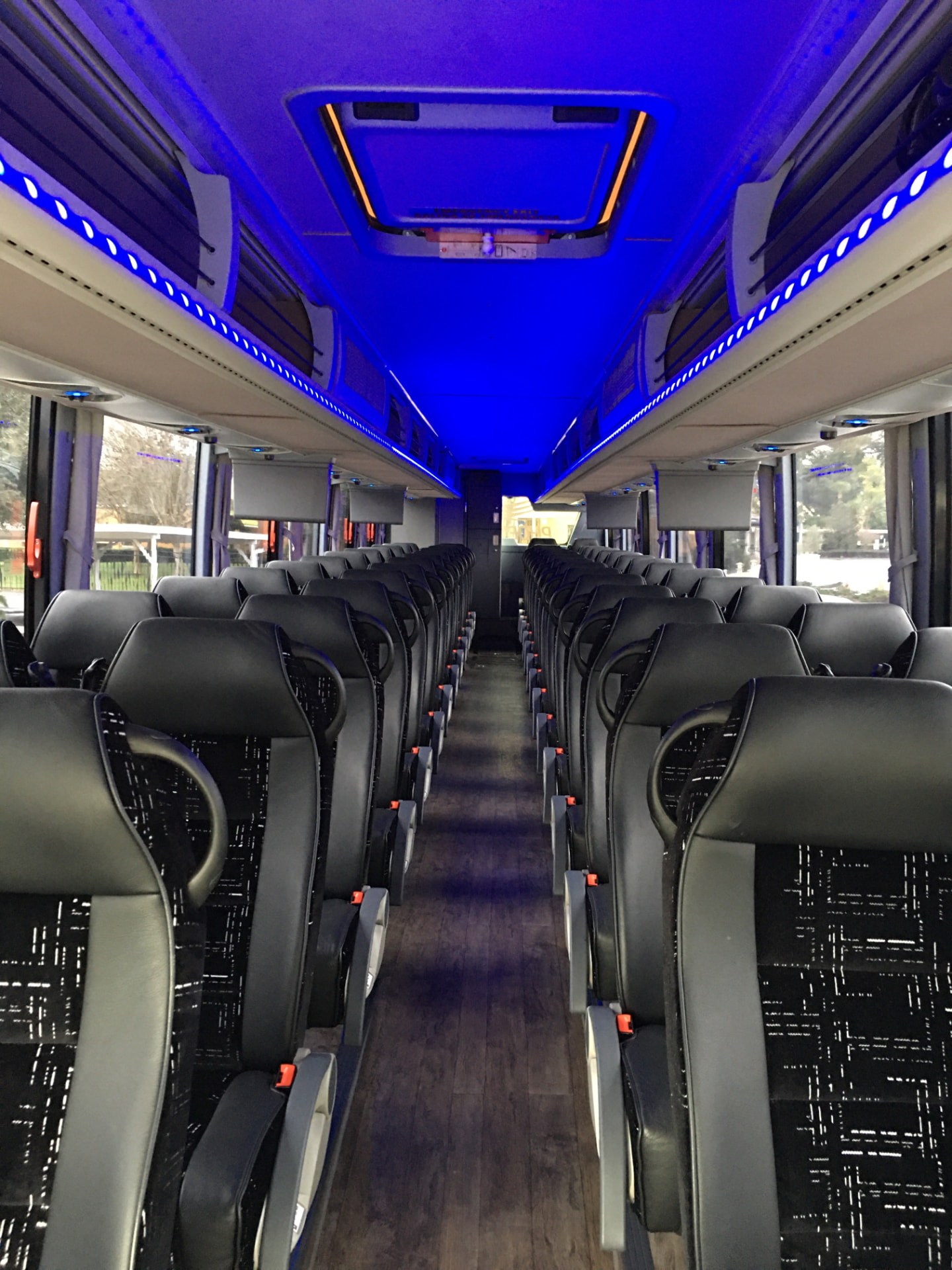
Every unit assigned to a workforce shuttle carries 3-point seat belts at each seating position, USB power outlets, heavy-duty high-output air conditioning, and executive LED cabin lighting for pre-dawn and overnight loops.
Executive LED cabin lighting for overnight and pre-dawn shift loopsUSB power, 3-point belts and high-output A/C at every seat row
24-Hour Continuous Operation — Davenport, FL
Phoenix Bus supports round-the-clock workforce transportation in Davenport, Florida, on the western edge of the I-4 corridor between Orlando and Polk County. The Davenport configuration is a continuous 24-hour operation: vehicles and drivers are staged on rotation so that every shift boundary in a three-shift, non-stop production cycle is covered without a service gap.
Overnight and early-morning loops covering shift boundaries outside standard business hours, including the 05:00 change.
Driver rotations and relief points pre-planned against FMCSA hours-of-service limits so no loop is dropped at a handover.
Off-site staging lot used as the continuous boarding point, with manifest control maintained on every run across all 24 hours.
Backup vehicle held in the rotation to absorb a mechanical failure without interrupting the shift cycle.
Fleet Capacity & Owned Equipment
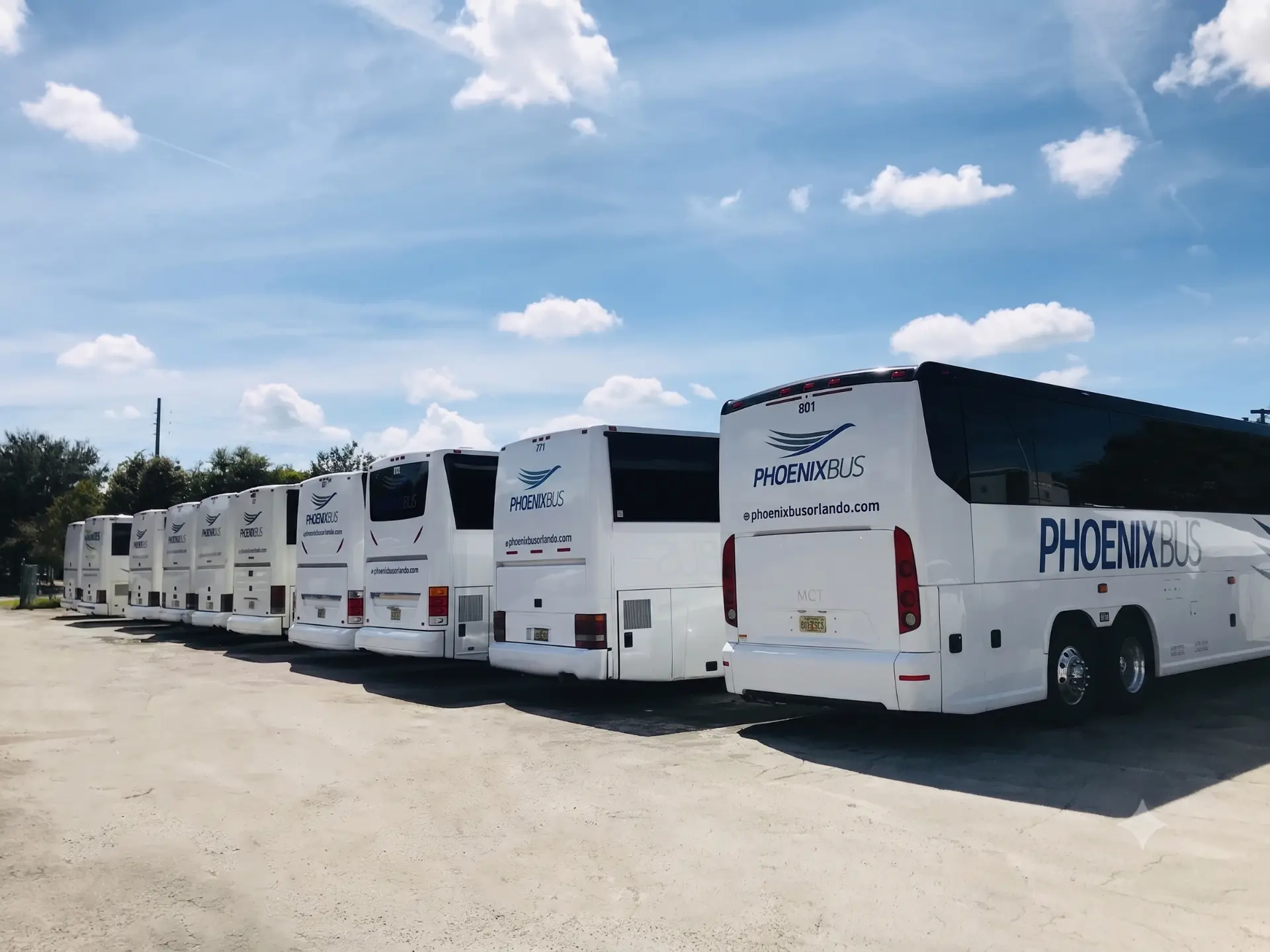
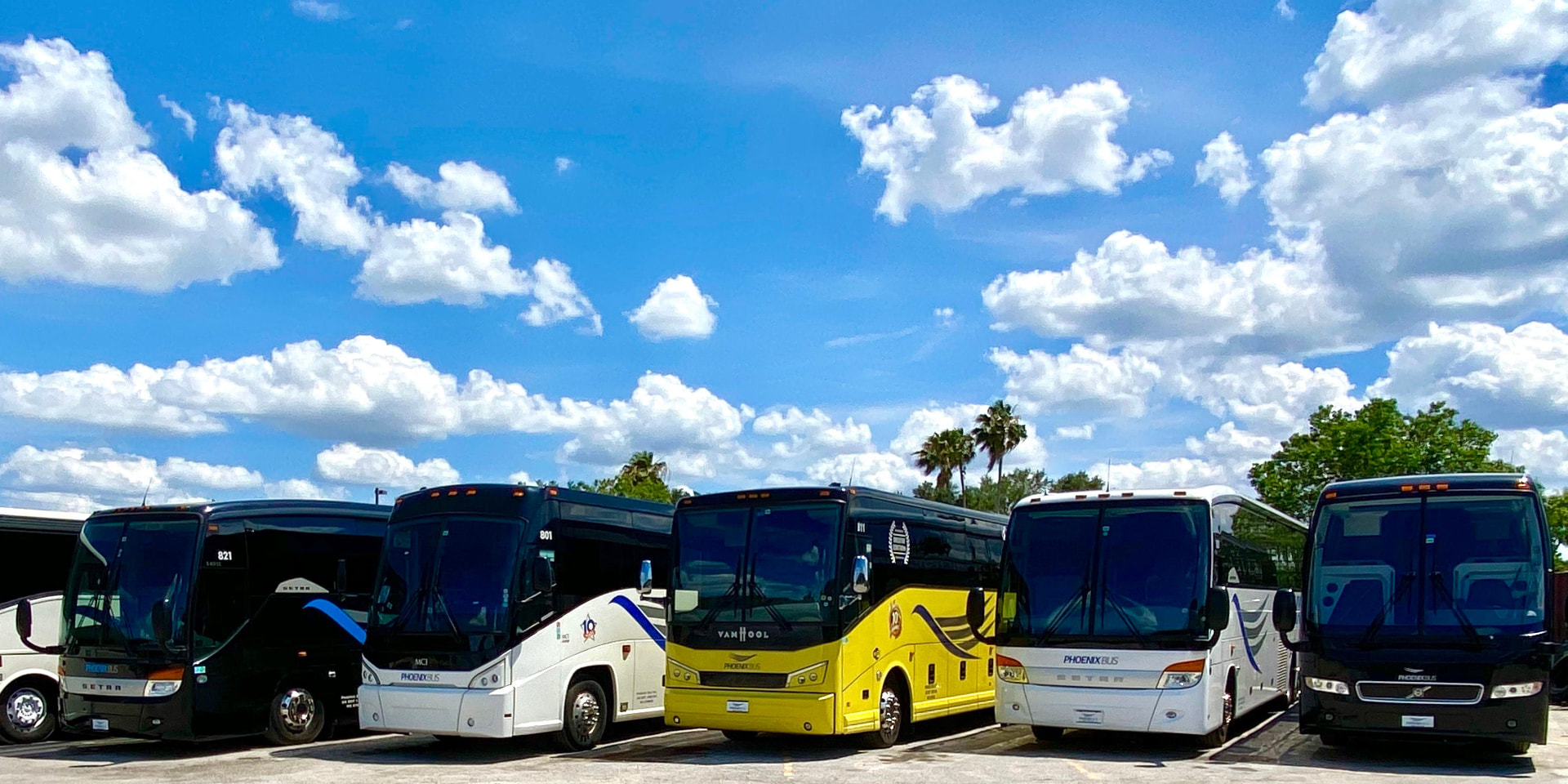
Corporate, federal, and DOD / DOW workforce contracts are staffed exclusively from our own yard — 60+ owned vehicles, in-house maintenance, and a named driver roster. No third-party carriers, and guaranteed backup units held in rotation for continuous contracts.
Owned motorcoaches staged for shift-change deploymentMixed-model fleet scoped to per-loop worker headcount
Owned & Operated Fleet of 60+ Certified Vehicles — 100% Direct Asset Logistics.
"From military base transfers to large-scale personnel shuttles, Phoenix Bus delivers every time with precision and safety."
Col. Robert Hayes
Logistics Coordinator
U.S. Department of Defense
"Phoenix Bus Orlando has been our go-to transportation partner for over 3 years. Their reliability and professionalism are unmatched."
James Mitchell
Director of Operations
Orange County Public Schools
"We trust Phoenix Bus for all our shuttle needs. Their fleet is modern, clean, and always on schedule."
Sarah Chen
Event Manager
Orlando Convention Center
Workforce Fleet & Onboard Amenities
Owned 56-passenger motorcoaches staged for shift-change loopsUSB power, 3-point seat belts, high-output A/C on every unitGate-controlled boarding at job sites and data center campuses
Construction shuttle contracts are priced on two variables only: the shift block you need covered and the worker headcount per loop. Rates are fixed in the agreement before the first run — no hidden fees, and 24/7 dispatch support is included.
Priced by Shift Block
Contracts are quoted on 8-hour, 12-hour, or continuous 24/7 shift blocks — matched to your 1st, 2nd, and 3rd shift boundaries.
Scaled by Headcount
Vehicle mix (14-passenger Sprinter, 24-35 mini-coach, 56-passenger motorcoach) is scoped to per-loop worker headcount, not guesswork.
No Hidden Fees
Fuel, driver hours, tolls, and insurance are stated in the rate agreement up front. Fixed-rate monthly invoicing on continuous contracts.
24/7 Dispatch Included
Central dispatch coverage, live schedule changes, and backup vehicle capacity are included in every workforce program — never billed as an add-on.
We maintain the highest safety standards in the industry, with certifications and protocols that give our clients complete peace of mind.
DOT Certified
Fully compliant with U.S. Department of Transportation regulations and safety standards.
FMCSA Authorized
Federal Motor Carrier Safety Administration registered and authorized carrier.
DOD / DOW Approved
Cleared and approved for Department of Defense military transportation contracts.
Student Transport Certified
Drivers and buses meet Florida student-transport safety requirements under USDOT and FMCSA oversight.
GSA Approved
General Services Administration approved vendor for federal government transportation contracts.
Operational Safety Standards
Beyond certifications, we implement rigorous operational protocols that ensure every trip meets the highest safety benchmarks. Our drivers undergo continuous training and our fleet is maintained to exceed manufacturer specifications.
100% DOT compliance record
Annual third-party safety audits
Drug & alcohol testing program
24/7 dispatch & emergency support
Defensive driving certified staff
Pre-Trip Inspections
Every vehicle undergoes rigorous 50-point inspections before each departure.
GPS Fleet Tracking
Real-time GPS monitoring on every vehicle for maximum accountability and safety.
Emergency Protocols
Comprehensive emergency response training for all drivers and staff.
Insurance & Compliance
Full commercial insurance coverage exceeding federal minimum requirements.
Trusted Partners
What Our Partners Say
Proudly serving government agencies, school districts, and Fortune 500 companies across Florida and interstate corridors.
"Phoenix Bus Orlando has been our go-to transportation partner for over 3 years. Their reliability and professionalism are unmatched."
James Mitchell
Director of Operations
Orange County Public Schools
"From military base transfers to large-scale personnel shuttles, Phoenix Bus delivers every time with precision and safety."
Col. Robert Hayes
Logistics Coordinator
U.S. Department of Defense
"We trust Phoenix Bus for all our convention shuttle needs. Their fleet is modern, clean, and always on schedule."
Sarah Chen
Event Manager
Orlando Convention Center
Contracts & Partnerships
Orange County Public Schools
U.S. Department of Defense
GSA Federal
Orlando Int'l Airport
Hilton Hotels
Universal Orlando
FAQ
Construction Site Shuttle FAQs
What is a construction and data center workforce shuttle?
For large-scale projects like data center builds, solar farms, and major infrastructure, on-site parking is often limited or unsafe. We provide high-capacity shuttles that move your workforce from remote staging lots or basecamps directly to the active job site, reducing congestion and ensuring workers arrive on time.
Do you have experience with multi-state data center and factory builds?
Yes. Phoenix Bus Orlando provides ongoing, large-scale employee transportation for complex construction projects, data centers, and factory operations across Florida and neighboring states. We engineer daily commuter routes that keep specialized corporate teams and contractors moving efficiently.
Can you align shuttle schedules with our 24-hour shift changes?
Absolutely. We build continuous, looping shuttle transfers customized to your project's AM/PM shift changes. Our 24/7 dispatch center monitors operations to ensure seamless handoffs, while strictly managing our personnel schedules to comply with federal DOT Hours of Service (HOS) safety regulations.
What type of vehicles are used for construction site logistics?
Vehicle assignment depends on your site access and passenger volume. We typically deploy 56-passenger motorcoaches or 52-passenger school buses for massive shift changes, and versatile 15-passenger cutaway shuttles for executive tours, engineering teams, or tighter access roads. All equipment is company-owned.
How is long-term construction shuttle service priced?
Ongoing construction shuttles are typically priced as a Multi-Service contract rather than a basic hourly rate. We build a unified, transparent pricing framework based on required vehicle hours, driver shifts, and operation days. Because we are a direct operator, there are no hidden broker fees.
Are your vehicles and drivers compliant with heavy-industry safety standards?
Safety is our baseline. Our fleet is maintained to rigorous FMCSA standards with 50-point pre-trip inspections. Every driver is an employee who has passed DOT background checks and drug testing, ensuring they meet the compliance requirements of highly secure corporate and federal job sites.
Get an Instant Free Charter Bus Quote — Available 24/7/365 — Florida & Interstate
Get a free, no-obligation quote today. Our team is ready to help you plan the perfect transportation solution.